Drilling and Training

Manual of Arms for World War One Soldier

School of the Soldier

From the Infantry Drill Regulations, 1911, Corrected to December 1917

48.  The instructor explains briefly each movement, first executing it himself if practicable.  He requires the recruits to take the proper positions unassisted and does not touch them for the purpose of correcting them, except when they are unable to correct themselves.  He avoids keeping them too long at the same movement, although each should be understood before passing to another.  He exacts by degrees the desired precision and uniformity.

49.  In order that all may advance as rapidly as their abilities permit, the recruits are grouped according to proficiency as instruction progresses.  Those who lack aptitude and quickness are separated from the others and placed under experienced drill masters.

INSTRUCTION WITHOUT ARMS.

50.  For the preliminary instruction a number of recruits, usually not exceeding three or four, are formed as a squad in single ranks.

Position of the Soldier, or Attention

51.  Heels on the same line and as hear each other as the conformation of the man permits.

Feet turned out equally and forming an angle of about 45 degrees.

Knees straight without stiffness.

Hips level and drawn back slightly; body erect and resting equally on the hips; chest lifted and arched; shoulders square and falling equally.

Arms and hand hanging naturally, thumb along the seam of the trousers.

Head erect and squarely to the front, chin drawn in sop that the axis of the head and neck is vertical; eyes straight to the front.

Weight of the body resting equally upon the heels and balls of the feet.

The Rests.

52.  Being at a halt, the commands are: FALL OUT; REST; AT EASE; and 1. Parade 2. Rest.

At the command fall out, the men may leave the ranks, but are required to remain in the immediate vicinity.  They resume their former places, at attention, at the command fall in.

At the command rest each man keeps one foot in place, but is not required to preserve silence or immobility.

At the command at ease each man keeps one foot in place and is required to preserve silence but not immobility.

53.  1. Parade, 2. REST.  Carry the right foot 6 inches straight to the rear, left knee slightly bent clasp the hands without constraint, in front of the center of the body, fingers joined, left hand uppermost, left thumb clasped by the thumb and forefinger of the right hand; preserve silence and steadiness of position.


54.  To resume the attention: 1. Squad, 2. ATTENTION.

The men take the position of the soldier.

Eyes Right or Left.

55.  1. Eyes, 2. RIGHT (LEFT), 3. FRONT.

At the command right, turn the head to the right oblique, eyes fixed on the line of eyes of the men in or supposed to be in the same rank.  At the command front, turn the head and eyes to the front.

Facings.

56.  To the flank: 1. Right (Left), 2. FACE.

Raise slightly the left heel and right toe; face to the right turning on the right heel, assisted by a slight pressure on the ball of the left foot; place the left foot by the side of the right.  Left face is executed on the left heel in the corresponding manner.

Right (left) half face is executed similarly, facing 45 degrees.

“To face in marching” and advance, turn on the ball of either foot and step off with the other foot in the new line of direction; to face in marching without gaining ground in the new direction, turn on the ball of either foot and mark time.

57.  To the rear: 1. About, 2. FACE.

Carry the toe of the right foot about a half foot-length to the rear and slightly to the left of the left heel without changing the position of the left foot; face to the rear turning to the right on the left heel and right toe; place the right heel by the side of the left.

58.  1. Hand, 2. SALUTE.

Raise the right hand smartly till the tip of the forefinger touches the lower part of the headdress or forehead above the right eye, thumb and fingers extended and joined, palm to the left, forearm inclined 45 degrees, hand and wrist straight; at the same time look toward the person saluted.  (TWO) Drop the arm smartly by the side.

For rules governing saluting, see “Honors and Saluted,” paragraphs 758-765.

STEPS AND MARCHING

59.  All steps and marchings executed from a halt, except right step, begin with the left foot.

60.  The length of the full step in quick time is 30 inches, measured from heel to heel, and the cadence is at the rate of 120 per minute.

The length of the full step in double time is 36 inches; the cadence is at the rate of 180 steps per minute.

The instructor when necessary indicates the cadence of the step by calling one, two, three, four, or left, right, the instant the left and right foot. Respectively, should be planted.

61.  All steps and marchings and movements involving march are executed in quick time unless the squad be marching in double time, or double time be added to the command; in the latter case double time is added to the preparatory command.  Example: 1. Squad right, double time, 2. MARCH (School of the Squad).

Quick Time.

62.  Being at a halt, to march forward in quick time: 1. Forward, 2. MARCH.

At the command forward, shift the weight of the body to the right leg, left knee straight.

At the command march, move the left foot smartly straight forward 30 inches from the right, sole near the ground, and plant it without shock; next, in like manner, advance the right foot and plant it as above; continue the march.  The arms swing naturally.

63.  Being at a halt, or in march in quick time, to march in double time: 1. Double time, 2. MARCH.

If at a halt, at the first command shift the weight of the body to the right leg.  At the command march, raise the forearms, fingers closed, to a horizontal position along the waist line, take up an easy run with the step and cadence of double time, allowing a natural swinging motion to the arms.

If marching in quick time, at the command march, given as either foot strikes the ground, take one step in quick time, and then step off in double time.

64.  To resume the quick time: 1. Quick time, 2. MARCH.

At the command march, given as either foot strikes the ground, advance and plant the other foot in double time; resume the quick time dropping the hands by the side.

To Mark Time.

Being in march: 1. Mark time, 2. MARCH.

At the command march, given as either foot strikes the ground, advance and plant the other foot; bring up the foot in rear and continue the cadence by alternately raising each foot about 2 inches and planting it on line with the other.

Being at halt, at the command march, raise and plant the feet as described above.

The Half Step.

66.  1. Half step, 2. MARCH.

Take steps of 15 inches in quick time, 18 inches in double time.

67.  Forward, half step, halt, and mark time may be executed one from the other in quick or double time.

To resume the full step from half step or mark time: 1. Forward, 2. MARCH.

Side Step.

68.  Being at a halt or mark time: 1. Right (Left) step, 2. MARCH.

Carry and plant the right foot 15 inches to the right; bring the left foot beside it and continue the movement in the cadence of quick time.

The side step is used for short distances only and is not executed in double time.

If at order arms, the side step is executed at trail without command.

Back Step.

69.  Being at halt or mark time: 1. Backward, 2. MARCH

Take steps of 15 inches straight to the rear.

The back step is used for short distances only and is not executed in double time

If at order arms, the side step is executed at trail without command.

To Halt.

70.  To arrest the march in quick or double time: 1. Squad, 2. HALT

At the command halt, given as either foot strikes the ground, plant the other foot as in marching; raise and place the first foot by the side of the other.  If in double time, drop the hands by the sides.

To March by the Flank.

71.  Being in march: 1. By the right (left) flank, 2. MARCH.

At the command march, given as the right foot strikes the ground, advance and plant the left foot; then face to the right in marching and step off in the new direction with the right foot.

To March to the Rear.

72.   Being in march: 1. To the rear, 2. MARCH.

At the command march, given as the right foot strikes the ground, advance and plant the left foot; turn to the right about on the balls of both feet and immediately step off with the left foot.

If marching in double time, turn to the right about, taking four steps in place, keeping cadence and then step off with the left foot.

Change Step.

73.  Being in march: 1. Change step, 2. MARCH

At the command march, given as the right foot strikes the ground, advance and plant the left foot; plant the toe of the right foot near the heel of the left and step off with the left foot.

The change on the right foot is similarly executed, the command march being given as the left foot strikes the ground.


MANUAL OF ARMS

74.  As soon as practicable the recruit is taught the use, nomenclature, and care of his rifle; when fair progress has been made in the instruction without arms, he is taught the manual of arms; instruction without arms and that with arms alternate.

75.  The following rules govern the carrying of the piece:

FIRST.  The piece is not carried with cartridges in either the chamber or the magazine except with specially ordered.  When so loaded, or supposed to be loaded, it is habitually carried locked; that is, with the safety lock turned to the safe.  At all other times it is carried unlocked, with the trigger pulled.

SECOND.  Whenever troops are formed under arms, pieces are immediately inspected at the commands: 1. Inspection, 2. ARMS, 3. Order (Right shoulder, port), 4. ARMS.

A similar inspection is made immediately before dismissal.

If cartridges are found in the chamber or magazine they are removed and placed in the belt.

THIRD.  The bayonet is not fixed except in bayonet exercise, or guard, or for combat.

FOURTH.  Fall in is executed with the piece at the order arms.  Fall out, rest, and at ease are executed as without arms.  On resuming attention the position of order arms is taken.

FIFTH.  If at the order, unless otherwise prescribed, the piece is brought to the right shoulder at the command march, the three motions corresponding with the first three steps.  Movements may be executed at the trail by prefacing the preparatory command with the words at trail; as 1. At trail, forward, 2. MARCH.  The trail is taken at the command march.

SIXTH.  The piece is brought to the order on halting.  The execution of the order begins when the halt is completed.

SEVENTH.  A disengaged hand in double time is held as when without arms.

76.  The following rules govern the execution of the manual of arms:

FIRST.  In all positions of the left hand at the balance (center of gravity, bayonets unfixed) the thumb clasps the piece; the sling is included in the grasp of the hand.

SECOND.  In all positions of the piece “diagonally across the body” the position of the piece, left arm and hand are the same as in port arms.

THIRD.  In resuming the order from any position in the manual, the motion next to the last concludes with the butt of the piece about 3 inches from the ground, barrel to the rear, and the left hand about and near the right steadying the piece, fingers extended and joined, forearm and wrist straight and inclining downward. All fingers of the right hand grasping the piece.  To complete the order, lower the piece gently to the ground with the right hand, drop the left quickly by the side, and take the position of order arms.

Allowing the piece to drop through the right hand to the ground, or other similar abuse of the rifle to produce effect in executing the manual is prohibited.

FOURTH.  The cadence of the motions is that of quick time; the recruits are first required to five their whole attention to the detailed of the motions, the cadence being gradually acquired as them become accustomed t handling their pieces.  The instructor may require them to count aloud in cadence with the motions.

FIFTH.  The manual is taught at a halt and the movements are, for the purpose of instruction, divided into motions and executed in detail; in this case the command of execution determines the prompt execution of the first motion, and the commands, two, three, four, that of the other motions.

To execute the movements in detail, the instructor first cautions: By the numbers; all movements divided into motions are then executed as above explained until he cautions: Without the numbers; or commands movements other than those in the manual of arms.

SIXTH.  Whenever circumstances require, the regular positions of the manual of arms and the firings may be ordered without regard to the previous position of the piece.

Under exceptional conditions of weather or fatigue the rifle may be carried in any manner directed.

77.  Position of order arms standing: The butt rests evenly on the ground, barrel to the rear, toe of the butt on a line with toe of, and touching, the right shoe, arms and hands, hanging naturally, right hand holding the piece between the thumb and fingers.

78.  Being at order arms: 1. Present, 2. ARMS.

With the right hand carry the piece in front of the center of the body, barrel to the rear and vertical, grasp it with the left hand at the balance, forearm horizontal and resting against the body.  (Two) Grasp the small of the stock with the right hand.

79.  Being at order arms: 1. Port, 2. ARMS.

With the right hand raise and throw the piece diagonally across the body, grasp it smartly with both hands; the right, palm down, at the small of the stock; the left hand palm up, at the balance.  Barrel up, sloping to the left and crossing opposite the junction of the neck with the left shoulder; right forearm horizontal; left forearm resting against the body; the piece in a vertical plane parallel to the front.

80.  Being at present arms: 1. Port, 2. ARMS.

Carry the piece diagonally across the body and take the position of port arms.

81.  Being at port arms: 1. Present, 2. ARMS.

Carry the piece to a vertical position in front of the center of the body and take the position of present arms.

82.  Being at present or port arms: 1. Order, 2. ARMS

Let go with the right hand; lower and carry the piece to the right with the left hand; regrasp it with the right hand just above the lower band; let go with the left hand, and take the next to last position in coming to the order.  (Two) Complete the order.

83.  Being at order arms: 1. Right shoulder, 2. ARMS.

With the right hand raise and throw the piece diagonally across the body; carry the right hand quickly to the butt embracing it, the heel between the first two fingers.  (Two) without changing the grasp of the right hand, place the piece on the right shoulder, barrel up and inclined at an angle of about 45 degrees from the horizontal, trigger guard in the hollow of the shoulder, right elbow near the side, the piece in a vertical plane perpendicular to the front; carry the left hand, thumb and fingers extended and joined, to the small of the stock, tip of the forefinger touching the cocking piece, wrist straight and elbow down.  (Three) Drop the left hand by the side.

84.  Being at right shoulder arms: 1. Order, 2. ARMS.

Press the butt down quickly and throw the piece diagonally across the body, the right hand retaining the grasp of the butt.  (Two) (Three) execute order arms as described from port arms.

85.  Being at port arms: 1. Right shoulder, 2. ARMS

Change the right hand to the butt.  (Two) (Three) execute order arms as described from order arms.

86.  Being at right shoulder arms: 1. Port, 2. ARMS

Press the butt down quickly and throw the piece diagonally across the body, the right hand retaining the grasp of the butt.  (Two) Change the right hand to the small of the stock.

87.  Being at right shoulder arms: 1. Present, 2. ARMS.

Execute port arms.  (Three) Execute present arms.

88.  Being at present arms: 1. Right shoulder, 2. ARMS.

Execute port arms.  (Two), (Three), (Four) execute right shoulder arms as from port arms.

89.  Being at port arms: 1. Left shoulder, 2. ARMS.

Carry the piece with the right hand and place it on the left shoulder, barrel up, trigger guard in the hollow of the shoulder; at the same time grasp the butt with the left hand, heel between the first and second fingers, thumb and fingers closed on the stock.  (Two) Drop the right hand by the side.

Being at left shoulder arms: 1. Port, 2. ARMS.

Grasp the piece with the right hand at the small of the stock.  (Two) Carry the piece to the right with the right hand, regrasp it with the left, and take the position of port arms.

Left shoulder arms may be ordered directly from the order, right shoulder, or present arms, or the reverse.  At the command arms execute port arms and continue in cadence to the position ordered.

90.  Being at order arms: 1. Parade, 2. REST.

Carry the right foot 6 inches straight to the rear, left knee slightly bent; carry the muzzle in front of the center of the body, barrel to the left; grasp the piece with the left hand just below the stacking swivel, and with the right hand below and against the left.

Being at parade rest: 1. Squad, 2. ATTENTION.

Resume the order, the left hand quitting the piece opposite the right hip.

91.  Being at order arms: 1. Trail, 2. ARMS.

Raise the piece, right arm slightly bent, and incline the muzzle forward so that the barrel makes an angle of about 30 degrees with the vertical.

When it can be done without danger or inconvenience to others, the piece may be grasped at the balance and the muzzle lowered until the piece is horizontal; a similar position in the left hand may be used.

92.  Being at trail arms: 1. Order, 2. ARMS.

Lower the piece with the right hand and resume the order.

Rifle Salute.

93.  Being at right shoulder arms: 1. Rifle, 2. SALUTE.

Carry the left hand smartly to the small of the stock, forearm horizontal, palm of hand down, thumb and forefingers extended and joined, forefingers touching the end of the cocking piece; look toward the person saluted.  (Two) Drop the left hand by the side, turn head and eyes to the front.

94.  Being at order or trail arms: 1. Rifle, 2. SALUTE.

Carry the left hand smartly to the right side, palm of the hand down, thumb and fingers extended and joined, forefinger against piece near the muzzle; look toward the person saluted.  (Two) Drop the left hand by the side; turn head and eyes to the front.

The Bayonet.

95.  Being at order arms: 1. Fix, 2. BAYONET.

If the bayonet scabbard is carried on the belt: Execute parade rest; grasp the bayonet with the right hand, back of the hand toward the body; draw the bayonet from the scabbard and fix it to the barrel, glancing at the muzzle; resume the order.

If the bayonet is carried on the haversack; Draw the bayonet with the left hand and fix it in the most convenient manner.

96.  Being at order arms: 1. Unfix, 2. BAYONET.

If the bayonet scabbard is carried on the belt: Execute parade rest; grasp the handle of the bayonet firmly with the right hand, pressing the spring with the forefinger of the left hand; raise the bayonet until the handle is about 12 inches above the muzzle of the piece; drop the point to the left, back of the hand toward the body, and, glancing at the scabbard, return the bayonet, the blade passing between the left arm and the body; regrasp the piece with the right hand and resume the order.

If the bayonet scabbard is carried on the haversack: Take the bayonet from the rifle with the left hand and return it to the scabbard in the most convenient manner.

If marching or lying down, the bayonet is fixed and unfixed in the most expeditious and convenient manner and the piece returned to the original position.

Fix and unfix bayonet are executed with promptness and regularity, but not in cadence.

97.  CHARGE BAYONET.  Whether executed at halt or in motion the bayonet is held toward the opponent as in the position of guard in the Manual for Bayonet Exercise.

Exercises for the instruction in bayonet combat are prescribed in the Manual for Bayonet Exercise.

The Inspection.

98.  Being at order arms: 1. Inspection, 2. ARMS.

At the second command take the position of port arms.  (Two) Seize the bolt handle with the thumb and forefinger of the right hand, turn the handle up, draw the bolt back, and glance at the chamber.  Having found the chamber empty, or having emptied it, raise the head and eyes to the front.

99.  Being at inspection arms: 1. Order (right shoulder, port), 2. ARMS.

At the preparatory command press the follower down with the fingers of the left hand, then push the bolt forward just enough to engage the follower, raise the fingers of the left hand, push the bolt forward, turn the handle down, pull the trigger, and resume port arms.  At the command arms, complete the movement ordered.

To Dismiss the Squad.

100.  Being at halt: 1. Inspection, 2. ARMS, 3. Port, 4. ARMS, 5. DISMISSED.
Tactics

Notes on Gas as a Weapon in Modern Warfare

Notes on Gas as a Weapon in Modern Warfare

Compiled from the latest Available Information

Army War College, April 1917

War Department Document No. 577

War Department,
Washington, April 28, 1917


The following Notes on Gas as a Weapon in Modern Warfare are published for the information and guidance of all concerned. 

[2582933-A, A.G.O.]

By Order of the Secretary of War:

H. L. Scott, Major-General, Chief of Staff.

Official:
H. P. McCain,

The Adjutant General.

Gas as a Weapon in Modern Warfare.

The use of various gases as weapons of offence in the present war has become so general that in any training of troops in the future a thorough knowledge of the technique of gas attack and the methods of defense against them must be included.

The use of gas, like many of the other weapons now in common use in the armies of Europe, such as the catapult, flame projector, trench knife, and sling is an inheritance from the early ages, amplified, improved and made more destructive by the aid of modern science.

The first recorded effort to overcome the enemy by the generation of poisonous and suffocating gases seems to have been in the wars of the Athenians and Spartans (431 to 404 BC), when besieging the cities of Platea and Delium the Spartans saturated wood with pitch and sulphur and burnt it under the walls of those cities in the hopes of choking the defenders and rendering the assault less difficult.  They also melted pitch, charcoal, and sulphur together in cauldrons and blew the fumes over the defenders’ lines by means of bellows.

“Greek fire” was used by the Byzantine Greeks under Constantine about 672 AD, to destroy the Saracens, and the Saracens, in turn, used it as a weapon of defense against the Christians during the crusades.  This Greek fire had the double advantage of being not only inflammable, but also generating during the process of combustion, clouds of dense, blinding smoke and gas of an asphyxiating character.  (This gas, sulphurous dioxide, is one of the gases used today.)  Its chemical composition was supposed to be a mixture of quicklime, petroleum, sulphur, and such other inflammable substance as pitch, resin, etc.  Upon the addition of water the slaking process which the quick lime underwent generated enough heat to ignite the petroleum, which in turn ignited the resin, pitch, and sulphur.  This flaming mixture was delivered against the enemy by means of fantastic syringes in the shape of dragons and other monsters with wide jaws.

The first use of gas in modern warfare occurred April 22, 1915, when the Germans liberated great clouds of gas against the allies’ trenches year Ypers, with a resulting complete demoralization of the troops and a large number of casualties.

Coincident with the use of the “gas cloud” the Germans began to use gas also in bombs, hand grenades, and shells.  The world was astounded at this resurrection of an ancient form of warfare, strictly forbidden by The Hague convention, but new weapons in war demand that they be met with similar weapons, and a week later the allies agreed to manufacture gas shells and use gas in other ways in retaliation.  From this beginning, gas has now become recognized as one of the accepted arms of the military service and is being used very extensively in all armies especially in the form of gas shells.

Instruction in the Methods of Gas Warfare

The importance of thoroughly instructing all soldiers in the methods of gas warfare and the methods of defense against it has been fully recognized in the armies of Europe.  The whole object of such instruction is to make every man thoroughly familiar with the conditions under which he will have to meet gas, and to make him proficient in the necessary measurers of defense.  This instruction is both theoretical and practical.  The theoretical instruction covers the methods of defense, including the actual exposure to gas.  In both England and France each district has one or more special antigas schools, where the specially selected officers and men are trained to enable them to impart this instruction to companies, troops and batteries.

The school at Aldershot may be taken as a type.  The training plant includes a lecture room with gassing apparatus and charts, a “gassing house,” and an area in which model trenches and dugouts have been prepared.

The gassing house contains one room 15 by 15 feet, with corridor entrances on either said and double doors to each corridor.  The purpose of these double doors is to prevent the escape of gas.  To give the men practical experience in enduring asphyxiating gases, protected by masks they are shut up in the room, masks are adjusted, and the gas turned on.

The dugouts have a corridor to them from the trenches, and in place of doors wet blankets reaching down to the floor are hung at either end of the corridor.  These wet blankets are to simulate the wet blankets which are actually used in the real trenches to prevent gas getting into the dugouts, and are used here to show the soldier that they really are a protection and keep out gases.

Trenches and dugouts so arranged are established at all training camps, and organizations are trained in turn in the actual experience of resisting gas attacks.  They enter trenches and dugouts; the alarm is given by beating on a gong and gas is turned into the trenches and dugouts.  At the beating of the gong each man must adjust his mask.  Before being given this actual experience with gas, each man is given a thorough course of instruction in the character of gases and drilled into the methods of defense against them.  In the 12 weeks’ course of training laid down for the infantry recruit he is given 1 hour antigas instruction each week.  As a part of this instruction he is practiced in running and exercising while wearing his mask.

Theoretical Instruction

Methods of making a gas attack. – Gases may be employed either in the form of “gas clouds” sent against the enemy’s trenches by means of a favorable wind or liberated in the trenches by means of hand grenades, rifle grenades, bomb, and shells.  There are various ways in which the gases forming the gas cloud may be liberated.  The most primitive (the “stinkpot” method) is the building of fires in front of the trenches in which either smoke clouds may be generated by the burning of pitch and petroleum, or lachrymatory gases may be generated by the burning of sulphur or a derivative of formol.  In the first case sulphurous anhydride is evolved and in the second formol in a gaseous state.  This generating of gases by the burning of fires has been practiced to some extent in the present war and is exactly the method practiced by the ancients.  The improved modern method, however, is the liberation of the gas from steel containers in which it is held under pressure in a liquid state.

These containers are distributed in batteries of three or four as intervals of about 50 yards along the trenches opposite the line to be attacked.  Tubes provided with a stopcock attachment are connected with the gas tanks and the end of the tubes passed over the parapet.  When an attack in intended a signal is given and the stopcocks are opened, allowing the gas to escape in the form of a dense vapor.  This escape of the confined gas is accompanied by a low whistling sound which, at night is frequently the only warning the opposing side has of the coming attack.

The success of the “gas cloud” is dependent on the atmospheric conditions.  A calm night or day, with a gentle wind blowing in the right direction is essential.  A strong wind distributed the gas too quickly and diminishes its concentration, and a variable wind is not to be depended upon; too much moisture in the air also neutralizes the gas somewhat and diminishes the force of the attack.  Before a gas cloud is made, therefore, the atmospheric conditions are studied, and the direction of the wind is determined by lighting small fired and watching the direction of the smoke, by letting up small balloons, or by the use of a weather cock.  These methods are visible sometimes and may give warning of an impending attack.

The gases used being heavier than air (chlorine is two and one-half and bromine five time as heavy as air), when released under proper atmospheric conditions, move, or rather appear to roll, along the ground usually in the form of a dense greenish yellow cloud toward the lines of troops to be attacked, and when it reaches the trenches it settles down into all parts of them, penetrating the dugouts and bomb proofs and remaining sometimes for several days.  The thickness of the cloud and the rapidity with which it approaches varies in accordance with the velocity of the wind.  Gas attacks have been made with velocities varying from 3 to 15 miles per hour, i.e. from 1 ½ to 7 ½ yards per second.  In an average 9-mile wind the gas would reach trenches 100 yards distant in 20 seconds.

While the gas cloud form of attack, if successful, can produce a number of casualties, its operation is uncertain, and its approach can be anticipated if proper watchfulness is maintained.  Efficient measures can be taken by trained troops to nullify its effects, and its military value, therefore, is probably not so great as when it is used in shells, bombs, hand grenades, etc.  This method is a much more definite procedure and will probably be used in all wars of the future.  Gas used in this way has a distinct military advantage in that it is possible to place it exactly where it may be needed to form a gas barrage or a smoke barrage to prevent the bringing up of reinforcements or the retreat of defeated troops.

Gas used in shells of both large and small caliber, but the 5.9-inch shells hold about 7 liters of a gas producing liquid.  They have a short ogival head and a long cylindrical body of thin steel, about one-fourth of an inch think; closely fitted against the walls is a cylinder of sheet lead about one-eighth inch think, which is filled with the gas producing liquid and then tightly soldered.  This lead container fills nearly the whole cylindrical portion of the shell.  Just above it but not resting on it, is the explosive, and above this, on the point of the shell, is the combination of time and impact fuse.  The effect of the charge upon exploding is to tear open the head of the shell and top of the lead container so as to allow the liquid to spill out and liberate the gas.

Hand grenades of various kinds, made of both glass and iron, and containing a quantity of gas-producing liquid are used in trench warfare, and iron bombs with a bursting charge of black powder and containing gas liquid are also used in trench mortars.

The Various Kinds of Gases

  1. Lachrymatory gases (which cause an intense inflammation of the eyes with temporary blindness).
  2. Suffocating gases (which cause rapid death by suffocation).
  3. Asphyxiating gases (which are extremely sever in their action and cause in many cases immediate death, in others a lingering death after several days, and in still others permanent disability).

The lachrymatory gases are the ones most commonly used in projectiles.  The asphyxiating and suffocating gases are the ones used in gas cloud attacks, but they are also used in projectiles.

A great variety of acids may be used for the production of gases and chemists in all armies are constantly experimenting with a view to perfecting new and more potent combinations.  The ones most commonly used now, however, for the lachrymatory group are combinations of benzol and acetone, with chlorine and bromine, such as chloracetone, bromacetone, and benzyl bromide.  The principal acids used for asphyxiating purposes are chlorine, bromine and phosgene.  These acids are abundantly produced in commercial processes of manufacture, and are easily obtained and answer every purpose.  They are, however, with the exception of phosgene, easily neutralized by alkalies.  In addition to these commoner acids, many other acids have been used.  Some of them are hydrogen sulphide, sulphurous anhydride, various nitrous vapors, formol, arsene, and prussic acid.

The Effects of Gases

Certain gases, such as prussic acid, produce instant death by paralyzing the central nervous system, but the majority of the gases have a special affinity for the mucous membranes, and their systemic effect depends on the amount of damage they to those tissues.  The lachrymatory gases have a special action on the membranes of the eye and upper air passages, and their effects, though sever while they last, are as a rule temporary.  They cause a severe smarting pain and running of the eyes (tearing), and soon the lining of the eyelids become so swollen that vision is impossible.  At the same times there is a dryness, burning, and smarting of the nose and throat, with coughing and sometimes vomiting.  In three or four hours these symptoms begin to disappear and gradually the soldier recovers.

The asphyxiating and suffocating gases are far more severe in their action.  Their potency can be realized when it is known that a dilution of 1:1,000 is fatal with chlorine and bromine and 1:25,00 is fatal with phosgene.  A dilution of 1:100,000 or more has a marked effect.  These gases act to a less degree on the membranes of the eyes than the lachrymatory gases, but their action is particularly virulent on the membranes of the respiratory tract, which they cause to swell rapidly and finally destroy.  The result is edema of the lungs, accompanied by persistent coughing and spitting of blood, then great difficulty in breathing, the soldier becoming cyanosed and struggling for breath.  Death may be almost instantaneous, or it may be postponed for several days, the sufferer in the meantime not being able to eat anything and undergoing great agony.  Many of the cases in which recovery does take place develop later a chronic disease of the lungs.

Methods of Protection

The deadly character of gas attacks can be almost entirely obviated if the proper means of protection are known and strictly enforced.  These are primarily:

1.  Prompt warning of an approaching attach; and 2.  Prompt application of the gas mask.  The rapidity with which gas clouds travel make it essential that warning of an approaching attack be given without delay, and that troops adjust their masks as rapidly as possible.

Advance warning of an attack can be frequently obtained by aeroplane reconnaissance and constant observation of the enemy’s trenches by outpost sentries.  These two sources of information should be continuously employed.  The only certain signs of an actual attack, however, are:

  1. The whistling sound of the gas as it escaped from the containers.
  2. The smell of the gas.
  3. The appearance of a cloud of any color over the enemy’s trenches.

(With all gases at night and with certain forms of gas in the day time the cloud is not always visible at a distance.)

Immediately upon the appearance of any of these signs the “gas alarm” should be given and masks put on instantly.

Gas Masks

A perfect familiarity with the use of the mask and its prompt application is the only certain means of defense.  This has been proven very thoroughly in the present war.  The casualties in the first attack at Ypers, where nothing was known as to the means of defense, were fully 25 per cent, while in recent attacks made on troops provided with the latest masks and thoroughly drilled in their use the casualties have been barely 1 per cent.  In the other instances, however, with the same masks, but in the hands of undrilled troops, the casualties have been large.

The development of gas masks has kept pace with the development of the use of gas in war.  Within two days after the attack at Ypers 100,000 masks had been prepared by the women of France and sent to the troops at the front.  These masks were, however, simply small pads of gauze and cotton tied over the mouth by means of string and of course did now answer their purpose.

All of the gas masks in use today provide mechanical protection to the eyes my means of goggles and chemical protection to the air passages by means of a mixture of various elements which neutralize the chemical action of the gas.  The fundamental principals underlying them are (a) the protection of the eyes without interference with vision and (b) the exclusion from the air passages of all air except that which has been passed through a neutralizing element.  The first is accomplished by means of goggles or eye pieces which fight tightly around the eyes.  The second is effected by means of various mechanical devices in which all the inspired air is made to pass through either a pad or cloth which has been previously treated with neutralizing chemicals or through a metal container which is kept filled with a neutralizing mixture.  The later has proven the best device and is now in use in practically all armies.

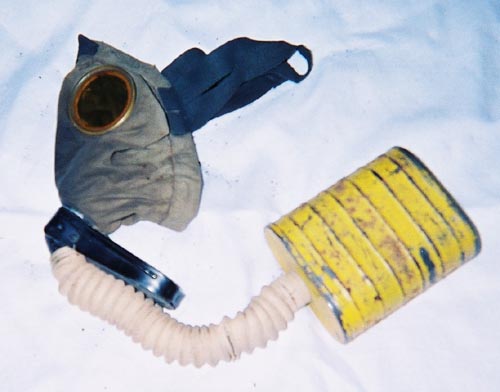
The English type of this mask is known as “the small box respirator.”  It comprises an impervious face piece or mask containing windows for the eyes, which is held in place by rubber bands around the head, a tin can or box carried in a small haversack, and a flexible, noncompressible tube connecting the box with the face piece.  Inside the face piece is a small wire clamp which, applied to the nose, prevents air from being inhaled through the nasal passages.  When the face piece is adjusted and the nose clamp in position, the wearer takes the end of the flexible tube in his mouth, and both inspiration and expirations is carried on through this tube.  The expired air finds exit through a rubber check valve just outside the mask, while the inspired air is taken in through a wire window in the bottom of the box.  In this box the neutralizing mixture is arranged in five layers, and in its passage through these five layers the gas-laden air is robbed of its poisonous qualities.

The German mask is somewhat similar to the English mask, but the container for the neutralizing mixture is screwed on to a ring in the bottom of the mask.  Inspired air and expired air both pass through the container.  In addition to the small box respirator type of mask, every British soldier is provided with a mask of the “tube-helmet” type, to be carried as a reserve.  This mask is really a cloth or flannel hood with a skirt long enough to be tucked under the collar of the coat.  It is provided with eye pieces and a tube and check valve arrangement, through which the expired air escapes.  Inspired air comes through the cloth of the mask, which has been impregnated with chemicals.  In addition to a mask somewhat similar to the English “respirator” type, the French army is equipped with a mask known as the M2 type.


This mask has a face piece with celluloid windows for the eyes and a crescent-shaped piece passing under the chin and well up to the ears.  The mask below the goggles is lined with a quilted pad of gauze soaked with neutralizing chemicals.  A piece of thick sheeting of pure rubber goes around the goggles on the inside and is stitched between the layers of quilted gauze to prevent air leaks.  The face piece on the outside is protected by a layer of waterproof cloth.

As gases have an effect on horses similar to that on men, masks are now being provided.  Horses and all animals when in the danger zone are masked.

Practical Instruction

Practical instruction should include the mechanism of the gas mask, and the manner in which it is used, and should be so arranged as to train the soldier in the quick and accurate application of his mask and to accustom him to the performance of his usual duties while wearing it.  In other words, every effort should be made to familiarize him with “the feel” of his mask and to establish his confidence in it.

The care of the mask should be explained and the absolute necessity for having it at all times nearby and in perfect condition dwelt upon.

The main point to be impressed upon the soldier is that the chemical material in the mask acts as a filter and that all air breathed into the lungs must first pass through this chemical material in order that the poisonous qualities of the gas may be eliminated.  There must therefore be no leaks in the mask, nor must it be removed until orders to do so have been given by the noncommissioned officer in charge of the trench section.

Mask Drill. – Mask drill should be carried out frequently by all ranks.  It should aim at teaching the quick adjustment of the mask under all conditions, accustoming the men to wearing them for a long time and taking exercises in them.  The following points should be noted:

  1. Men should be timed in removing the mask from container and getting it properly adjusted on the face.  This should only take a few seconds, and the importance of developing quickness and dexterity in the men in the application of their masks can not be overestimated.  Men should be taught to hold their breath while putting on the mask, as a few breaths drawn in concentrated gas may be followed by serious results.
  2. Practice simple movements while wearing the mask, physical drill, setting up exercises, short running exercises, etc.  At first these exercises should not exceed 15 minutes but should be gradually extended.  Men must be accustomed to wearing their masks for at least one hour.
  3. The care of the mask, method of keeping the eyepieces clean, etc.
  4. Practice in bombing, rapid loading, and aiming, judging distance and range practice while wearing the mask.
  5. Practice in attacking trenches and in use of bayonet.

As an evidence of the minuteness and exactness which is required in instructing soldiers in the application of the gas mask, the following may be quoted from the English drill regulations”

Practice A. – Adjustment of the respirator box in the “alert” position.

On the command “Gas alert” hang the box respirator around the neck with the press button next the body.  With the right hand seize the satchel by the leather tab, and with the left hand seize the sling by the brass button and slip this into the leather tab.  Undo the press buttons closing the satchel, tuck in the slack of the sling into the left hand compartment, so that it lies under the mask.

The length of whipcord will then be withdrawn from the right hand compartment, passed through the ring on the right of the satchel, and carried around the waist tot he ring on the left, where it is fastened.

The press button closing the satchel will be left undone, but the flap will be put in position to keep the respirator from wet.

Practice B – Drill by numbers to obtain correct adjustment of the small box respirator.

Note. – This drill is to be carried out alternately with one “judging the time,” i.e. as quick adjustment as possible.  It is most important, and complete adjustment must be obtained by all ranks in six seconds.

Adjust the respirator in the alert position, with the satchel covered but not buttoned.

  1. On command “One” press down both thumbs between the satchel and the body and open the satchel flap.  Immediately seize the mask with the right hand, the metal breathing tube just outside the mask being in the palm of the hand and the thumb and first finger grasping the wire frame of the nose clip.
  2. On the command “Two” bring the mask smartly out of the satchel and hold it in both hands with all the fingers outside round the binding, and the two thumbs inside, pointing inward and upward under the elastic.  At the same time throw the chin well forward ready to enter the mask opposite the nose clip.
  3. On the command “Three” bring the mask forward, digging the chin into it and with the same motion bring the elastic bands back over the crown of the head to the full extent of the retaining tape using the thumbs.
  4. On the command “Four” seize the metal breathing tube outside the mask, thumb on the right, fingers on the left, all pointing toward the face.  Push the rubber mouthpiece well into the mouth and pull it forward until the rim of the mouthpiece lies between the teeth and the lips and the two rubber grips are held by the teeth.
  5. One the command “Five” adjust the nose clip to the nose, using the thumb and first three fingers of the right hand.  Come smartly to attention.

Practice C – Drill to teach the cleaning of the eyepieces. On the command “Clean eyepieces” the right eyepiece will be gripped between the thumb and first finger of the left hand.  The first finger of the right hand will then be pushed gently into the flap of the mask behind the right eyepiece, which will be cleaned with a gentle circular motion.

The left eyepiece will be cleaned in a similar way.

Practice D – Drill to teach method of giving orders. – It is first explained to a squad that the nose clip must not be removed to talk, and that before each sentence is spoken a long breath must be taken and the mouthpiece removed sideways from the mouth by turning the metal tube outside the mask to one side.  After speaking the mouthpiece is replaced.

The squad should then be numbered off, extended to four paces, and orders passed along the line.

Officers and noncommissioned officers will receive instructions in practice D.

Practice E – Drill to teach method of clearing mask from gas which may have leaked in and is affecting the eyes. – Press the mask close to the face, forcing out foul air round the sides, and then fill again with air from the lungs by blowing out around the mouthpiece.

Practice F – Drill to teach method of testing whether trench or dugout is free from gas. – With the right hand open the face piece away from right cheek, then loosen the nose clip on the nose and smell gently (do not take a breath).  If the gas is smelled, the nose clip and mask are replaced.  Then as in drill “E.”

Practice G. – Ordinary infantry drill will be carried out while wearing the mask.  This will include doubling for at least 200 yards at a time.  Marching order will be worn.  Musketry and bombing instruction and training specialists (including artillery, machine gunners, signalers, R.A.M.C.) will also be carried out.

Practice H – Drill to teach changing from the small box respirator to the tube helmet. – On the command “Change” hold the breath, knock off the steel helmet with the right hand, pull off the mask by inserting the fingers of the left hand under the mask at the chin, and then get on the tube helmet.  When the chin grip is obtained, commence breathing again.

Protecting must be obtained in 10 seconds or less.

Note. – (a) if after wearing for a long time the pressure of the nose clip becomes unbearable, it may be relieved for a few moments by taking off the pressure without removing the clip.

(b) Removing masks. – It must be seen that when the masks are removed this is done without strain on the face piece or elastic.  On the command “Take off masks,” insert the fingers of the left hand under the mask at the chin, bend the head forward, at the same time removing the mask with an upward motion of the left hand.

(c) After all drill the mouthpiece must be disinfected, the mask wiped dry, folded correctly and put away in such a way that the rubber valve is not bent.

Having become thoroughly accustomed to the use of the mask, all ranks should be given an actual exposure to gas in the training trenches.  This exposure should simulate in every way an actual gas attack.  At the gas alarm every man should promptly adjust his mask, and inspection should be made to see that this has been properly done.  The gas should then be turned into the trenches and the men kept in it for sometime.  Practice in clearing the trenches and dugouts of gas should be given and the men trained in the use of gas fans and sprayers.  Finally they should be practiced in the methods of determining whether or not all gas had been gotten rid of and if the mask can be safely removed.

General Regulations

following general regulations governing gas attack should be published, and all officers and men should be required to be familiar with them:

1. Every officer is responsible that the men under his command are properly instructed in defensive measures against gas attacks, and that standing orders on the subject are thoroughly understood.  The experience in Europe has shown that in order to reduce gas casualties to a minimum the utmost care must be taken –

  1. in inspection of masks
  2. In training all men in quick adjustment of their masks under all conditions
  3. To insure that every man, whether, in front or in the supporting lines, shall be given immediate warning of an impending attack.

If the above conditions are fulfilled and the nature of the gas attack understood and protective measures are carried out automatically as the result of effective training the effect of the gas attack becomes very small.

The rapidity with which the gas cloud travels makes it essential that troops should adjust their masks as rapidly as possible, and that warning of an approaching gas attack should be given without delay.

2. Wind observations. – Wind observation should be made at regular intervals by officers detailed for that duty in all units in the front line, so that warning may be given when conditions are favorable for a hostile gas attack.

3. When the wind is favorable for a gas attack. –

  1. At night sentries should have at least two men in reach of them so that the alarm can be spread rapidly.
  2. A sufficient number of sentries should be posted over large dugouts or groups of dugouts to insure that all sleeping men can be aroused without delay.
  3. When thought necessary an additional inspection of masks should be made.
  4. Sentries should be told off for warning the company and regimental headquarters, and the artillery observation post, if there be one in the trench.
  5. At night and at all times when a gas attack is expected men in advance trenches will have masks in instant readiness to apply.
  6. Commanders of all units in camp or billet in rear of the trenches, but within the area of danger from gas, will make the proper arrangements for giving the alarm and rousing all men on receipt of information of a gas attack.

4. Gas Alarm. – Appliances for giving the alarm in cases of gas attack must be carefully arranged in advance.  These should be of two kinds.  The first in the form of gongs or bells, etc., at each company sentry post which will be beaten or rung directly gas is detected and will arouse the men in their immediate vicinity, the signal being passed along by all sentries as soon as heard.  The second kind will be for the purpose of conveying the alarm to troops in support or reserve lines and should be loud horns worked by compressed air or motor (Klaxon horns) in order to supplement wire communication should the latter break down.

No reliance can be placed on methods of communication involving the use of the lungs, e.g. bugles, whistles or telephones.  Sentries must be prepared to give the alarm on the first sign of gases, a few seconds delay may involve serious consequences.

5. Action to be taken on gas alarm signal. –

  1. Everyone put on masks.
  2. Rouse all men in trenches and dugouts.  Warn officers and artillery observation posts etc.
  3. Company commander call for artillery support and warn headquarters and troops in rear by means of prearranged signals.
  4. Infantry man parapets and open fire with rifle and machine guns, and where practicable, trench mortars on the trenches from which the gas is issuing.
  5. Let down and fix carefully the blanket curtains at entrances to cellars and dugouts so protected.

6. General precautions during gas attacks. – Officers and noncommissioned officers must not take off their masks to give orders.  Men must always be on lookout to help each other in case a mask is damaged.  When a man is wounded, he must be watched to see that he does not remove his mask.  If necessary his hands should be tied. 

Men must be warned that if they are slightly “gassed” before adjusting their masks they must not remove them.  The effect will wear off.  After the cloud has passed and the trenches been cleared of gas by the apparatus provided for the purpose the noncommissioned officer in charge of the trench section will assure himself that the trench is free from gas by rising his mask slightly, and will then issue the order to take off masks.  Men will on no account take off their masks until the order to do so has been given.  Dugouts and bombproofs must be entered with caution even after the trenches are clear, as gas frequently remains in them some hours.

Rifles and machine guns should be cleaned after an attack, as the gas affects them injuriously.  If ammunition boxes are kept closed and machine guns, rifles, and ammunition not in boxes are kept well oiled and are fired occasionally during a gas attack, there is little risk of jamming.  Oil cleaning will prevent corrosion for 12 hours or more, but the first available opportunity should be taken to dismantle the gun and clean parts in boiling water containing a little washing soda.  If this is not done, corrosion continues slowly, even after the oil cleaning, and may ultimately put the gun out of action.

Battery commanders should be reminded that aiming posts are liable to be obscured by the gas cloud, and that arrangements should be in every batter to meet this eventuality by providing gun pits with means to check the line of fire, if necessary, without depending on aiming posts.

7. Masks. – The mask is the main defense against a gas attack, and great care must be taken by the officer to insure that the masks are in good order and that the men have been trained in their use.  Masks issued to officers and men should be invariably kept on the person at all times.  This refers not only to units in the trenches, but to all units and individuals when within 4 miles of the front line.  They will be carried in containers on the outside of the coat or overcoat so that they are readily accessible at all times.  They must be kept from exposure and wet and only removed from containers for inspection.

Masks should be inspected once a week or more frequently if a gas attack is eminent.  Great care must be exercised to see that they are at all times in perfect conditions.  To prevent dimming of the eyepieces from condensation of moisture a proper chemical paste should be issued, to be applied to the inner surface of the windows.  A little of the paste should be applied with a dry rag to the inside of the eyepieces, rubbing it hard into the glass.  Then polishing off as much as possible with a fresh rag, leaving the glass quite clear.  This process must be repeated at each weekly inspection and after the goggles have been worn.

8. Gas-shell attacks. – The purpose for which gas shells are usually employed is to produce a barrage to prevent the bringing up of supports.

The liquid contained in these shells is usually the lachrymatory gas and converted into a dense white cloud of vapor by the explosion.  This causes intense irritation and watering of the eyes, and is often sufficiently concentrated to irritate the throat and cause coughing and sometimes vomiting, but is not deadly like asphyxiating gases.  The latter are sometimes used in shells, however, so that upon the first intimation of a gas shell attack the mask should be applied.

9. Methods of clearing gas out of shell holes and trenches. – During an attack the gas sinks into the dugouts, and when gas shells are used it sinks into the crater made by the shell and remains in these places a long time, as it is difficult to clear out.  Gas may be almost entirely kept out of dugouts by hanging damp blankets over the entrances into them.  This method should be universally adopted by artillery batteries, at regimental, brigade and division headquarters, and wherever dugouts and cellars are used within the shelled area.  The blankets must be kept wet to effectively exclude the air currents.  Shell holes which are so situated as to be obnoxious should be filled up with fresh earth, care being taken to cover up all places around the hole where the chemical liquid from the shell has dropped.  Shell holes so treated should not be disturbed, as the chemical is not destroyed by burying, and only slowly disappears.

After the cloud has passed gas may be cleared out of the trenches by the use of chemical sprayers and fans.  These should be distributed at easily accessible points in or near the trenches and protected from shell fire.  These sprayers are similar to the tree sprayers of commerce and are kept filled with a liquid alkali which has the property of neutralizing asphyxiating gases, but has no effect on lachrymatory gases.  The latter must be dissipated by ventilation of dugouts and the use of fans.  When a carbon monoxide gas is present in a dugout the ordinary mask is no protection.  For this reason special oxygen containers must be provided for the use of men engaged in clearing out the dugouts.  This latter is accomplished by burning waste soaked with crude oil in an iron firepot.  Where the dugouts are properly ventilated the heated air causes a current which quickly clears the dugout.  Each company should have a noncommissioned officer in charge of a squad of men trained in the care and use of the sprayers and fans.  On taking over trenches this noncommissioned officer will take over from the outgoing gas noncommissioned officer the sprayers and fans and will see that each is in good condition and that each sprayer is provided with solution.  A man will be assigned to each sprayer.  He will be responsible for testing it every day and in gas of gas attack he will be held responsible that all the above measures are properly applied from the moment that he takes over a sector of trench.

The Tactical Employment of Gas in Offense

The above resume of the use of gas in the European armies deals entirely with the question of defense against gas attacks and the precautions and methods of instruction that must be instituted to minimize their effects.  Gas having been generally adopted in all armies, however, a knowledge of the technique of its employment in offense must also be considered.

As has been noted above, gas may be employed in the form of gas clouds or waves, gas shells gas trench mortar bombs, hand bombs and grenades.  The proper use of gas in the form of a cloud attack is of so technical a character that its employment should be delegated to specially trained gas companies attached to each division.  In the English Army an entire brigade of Royal Army engineers has been organized for the gas offensive.  This brigade is under the command of a general officer attached to army headquarters.  When a gas cloud attack has been decided upon the gas officer should make a survey of the sector involved and designate the location of the batteries of gas containers.  These batteries, which may vary from 3 to 12 containers, are placed in specially prepared emplacements under the front line parapets and thoroughly protected from shell fire.  Inasmuch as the trenches never follow a straight line the batteries must be so located that when the gas is released it will not “enfilade” the trench containing them.  Advantage must be taken of salients so facing the enemy that the wind will carry the gas in the proper direction.  The best distribution of the gas can be accomplished with batteries placed at intervals of from 30 to 40 yards.

The weather conditions being of such great moment in the proper accomplishment of a gas cloud attack, they should always be studied thoroughly.  To this end meteorological stations should be established along the front and daily observations recorded, tabulated and charted.  The ideal weather is a gentle wind blowing in the right direction at a rate of 4 to 6 miles per hour; fairly high humidity, 40 to 60 per cent, and an overcast sky.  The upward current of warm air on a sunny day rapidly dissipates the gas and on such a day the best time for attack is in the early morning or late afternoon.

The order for the attack should be given in detail.  It should state that at _____ hour on the first day when the weather conditions are suitable a gas attack will be made on _____ sector of the front and the number of gas waves (rarely more than three) and the time for releasing each wave (so many minutes after _____ hour) will be started.  Each day of the week should be given a code designation for some days in advance.  By this means when the proper weather condition arrives, notification of attack can be given by signaling the code name.  The artillery should have orders to open fire on the enemy trenches immediately after the gas wave has arrived and a heavy barrage fire also instituted to prevent the bringing up of reinforcements.  For this barrage gas shells are especially useful.

Method of Making a Gas Attack

The gas wave attack is practically always followed by and infantry attack, and therefore the most perfect coordination is necessary between the gas detail, the artillery, and the infantry.  When an attack is to be made, men are placed in charge of each battery to release the gas when the order is given.  Each battery is connected by telephone with an officer of the gas service responsible for a given sector of the front and he in turn with the line officer commanding that sector.  The latter is connected with local and distant meteorological stations and with artillery headquarters.

The time for delivering the infantry attack will vary somewhat with the atmospheric conditions under which the gas was liberated.  Sufficient time should elapse for at least part of the gas to have disseminated, for with an efficient barrage fore there is little chance of reinforcement being brought forward.

Gas shell attacks are also dependent to some extent on the condition of the weather.  Inasmuch, however, as by means of projectiles the gas can be liberated directly in the enemy’s lines, weather conditions are not nearly so important as they are in the gas cloud attack.

The employment of gas shells may be in conjunction with a gas cloud attack, or an infantry attack without preliminary gas cloud attack.  As mentioned above, their greatest usefulness is in establishing a heavy barrage to prevent the bringing up of reinforcements.  They may also be used for preliminary bombardment of the trenches, the noxious gases they liberate materially weakening the defense in many instances.  Gas shells are also of distinct value in directing artillery fire.

Issued equipment

Restoring a World War One M1917 Helmet

Restoring the M1917 Helmet

By Vincent Petty

For anyone getting into WW1 living history finding a good serviceable helmet with a well-preserved liner can be a difficult task (and as well preserved helmets become more difficult to find, they should be left to institutions and collectors that can conserve them properly). At one time prices were reasonable, but, as we approach the centennial of the Great War, not only does the value of collector quality helmets continue to increase but so does the prices for even lesser and poorer quality helmets.  With this in mind, one option available to the reenactor is the restoration of a helmet.  I have restored a few helmets over the last few years and I would like to share some of my experiences in this article.

The first step to restoring a helmet is locating a suitable helmet shell.  Helmet shells with no liner and no original finish can still be found rather cheap.  When considering a possible helmet shell, ensure that the bails and the metal tabs that affix the bails to the helmet remain intact and sound.  While these can be re-manufactured and replaced, such work may be too difficult for those with little metal working experience or restoring their first helmet.  The shell itself need not be in the greatest shape, a little surface rust or pitting is acceptable.  Rust is easily cleaned off or even stabilized with a chemical treatment and pitting can be filled – I have previously used JB Weld.  Once the shell is selected, clean and treat it as necessary and prepare it to be painted.

My next step to restoring the helmet was finding an Olive Drab paint that I was satisfied with. There was any number of variations on the color Olive Drab during the World War and one option would be to have a paint mixed at a hardware store. I would be able to achieve the OD shade that I wanted; however, while the color is correct the paint — acrylic or latex — is not and would be susceptible to peeling. Another drawback is that such paint would have to be applied with a brush, leaving brush strokes and standing out as hand painted rather than factory mass produced. For me, the ideal paint would be OD green spray enamel.

I found what I thought to be ideal paint when a friend turned me on to Brownells, Inc. Brownells is a dealer of parts and tools for gunsmiths and shooters and among their products is camouflage paint. I ordered their “Olive Drab” and found that it was within the OD shade that I was looking for. The particular color appears in Brownells catalog as item #040-009-870 “Olive Drab Camo Paint.” Its brand name is Aervoe “987A Olive Drab.” The paint cost $5.95 for a 12 ounce can. Though I choked when I learned that it cost $7.25 to ship the single can.

Once I had my paint I had to then re-create the sawdust. In playing around with sawdust at work and at home I found that the ideal sawdust came from particle board. I simply took a small piece of scrap and ran a sharp scraper or a rasp along the edge of the board creating saw dust and catching it in a dustpan. Another option is to use a hand saw and make a series of cuts to create the sawdust.  I found that the dust from the particle board was very similar to the sawdust on the helmet. I also noticed that the sawdust on my original helmet was somewhat fine. As a result, I sifted through the sawdust I was making, trying to ensure that I had the smaller and removing the larger. I found that finer sawdust is best and the paint will build upon the sawdust, making it seem larger.

Once I had the paint, saw dust and the cleaned and prepped the helmet it was time to actually start painting. I started off by painting the inside of the helmet and allowing it to dry. After the interior was dry I flipped the helmet shell over and gave the helmet a light coat of paint and allowed it to dry as well. After “priming” the shell I painted a section of the helmet and immediately applied the sawdust to the wet paint. To apply the dust to the paint I pinched it between my thumb and index finger and sprinkled it as one might sprinkle salt. However, work quickly to apply the sawdust while the paint is wet. I worked the helmet in sections by spraying a small area and then applying the sawdust and then lightly painting over the applied saw dust. I also made sure that I overlapped the application, working around the brim, the crown and then the top. Once I was pleased with the amount of sawdust applied to the helmet, I gave it an even coat of paint and allowed it to dry. Once dry I ran my hand over the helmet to “break” off any of the sawdust that was not fully adhered and then gave it one last coat of paint. The end result was that I have a helmet that looked just as good as my original, but newer.

Once the helmet was painted a liner then needed to be installed. I purchased my reproduction liner from Prairie Flower Leather Company in Nebraska. I found that they had the best reproduction liner available and cost $55.00. Installing the liner was easy and took about ten minutes to do. The liner was laid into the helmet, chin strap fed through the bail rings and assembled using the split rivets and then the copper rivet fed through the hole in the chin strap and the top of the helmet. The only thing that I could not do was peen the rivet by machine as the originals were, but I had to peen it by hand. Trim the rivet a little and then place it against a sturdy surface (I used an anvil at work for peening rivets) and with a ball peen or riveting hammer peen the rivet enough so that it will not pop out.

The first helmet I ever restored the paint had cost $12 and the liner $50, but the shell had not cost anything. Once I had finished the painting, application of the sawdust and installation of the liner I had a helmet that I was very pleased with and which cost at most $65 to restore. I also had a helmet that looked new rather 80 years old.

The following are my sources for paint and reproduction helmet liner:

Paint
Brownells, Inc
200 South Front St.
Montezuma, Iowa 50171
800-741-0015
Website — http://www.brownells.com/

Army Culture

World War One Doughboy Slang

Doughboy Slang

Triangle man — A YMCA worker. One of the kinder euphemisms the doughboys had for the YMCA, an organization that the doughboy did not hold in high regards.

He’s Jake with me — A right guy, or someone you can depend on. “That Travis Haymaker, he’s Jake -with me. ”

To the mustard — Also someone you can depend on or something that is acceptable. “Tim Carr is to the mustard. ”

On the square — Someone you can depend on, or honest “Mickey is a squad leader who is on the square!” “Sure we had some bad numbers — you always do — but by and large we were on the square. ”

Sam Browne — Enlisted slang for officers for the Sam Browne belts they wore.

Raising the old Harry — Causing trouble or raising a ruckus. “That Poncho Villa was raising the ol’ Harry down on the border. “

But it was no soap — An event or a plan that didn’t happen or take shape. “Some of the boys wanted to get over to Paris, but it was no soap. ”

In the soup — To be in trouble. “It’s a good thing the Germans didn’t ‘t hit us or we ‘d be in the soup. ”

Joe Latrinsky — “Captain of the latrine” it means a rumor. “According to Joe Latrinsky we are going over the top.”

These slang terms were gleaned from the book “Make the Kaiser Dance; The American Experience in World War I ” By Henry Berry. Berry’s book is a collection of interviews made with AEF veterans in the mid-1970’s.

Issued equipment

Restoring a World War One Gas Mask

Restoring the Small Box Respirator Gas Mask
By Vincent Petty

Note: This article was written about 2002, at a time when reproduction US gas masks were difficult to come by and the only option was the use of originals.  However, ten years later accurate quality reproduction gas masks are available from Schipperfabrik, and we no longer recommend the use of original gas masks by living historians and reenactors.  This article is therefore only offered to show what living historians had to do to assemble accurate clothing and equipment. — VAP

For the living historian portraying the American soldier of the First World War, probably the most crucial and yet most difficult piece of equipment to acquire is the small box respirator gas mask. For the Doughboy reenactor, there are few available resources for serviceable gas masks. Few vendors offer reproduction masks, and when produced, they are usually in small production runs selling out quickly. The use of original gas masks is even more difficult because, after nearly 90 years, those available are in such poor condition as a result of time and improper storage. However, the use of an original mask is a viable option and with just a little work an original mask can be made serviceable again. Recently I restored an original gas mask that was purchased off of E-bay, and through this article, I would like to share the techniques that I used to make a serviceable gas mask for living histories and reenacting purposes.

Very rarely will one find an original gas mask where both the hose and mask are supple and pliable. However, a mask in this condition will be priced accordingly and honestly deserves to be preserved rather than used for reenacting. Usually, an original gas mask is found in one of two possible conditions – with a supple and pliable mask and fried hose or with both a fried mask and hose. “Fried” usually refers to the hard and crumbling condition of the rubber in the gas mask and the hose, as a result of age as well as poor storage in attics for decades.

The mask that I restored was purchased on E-bay for $23.00. When the mask arrived I found that the rubber hose was hard and crumbled in places and that the rubber in the facemask was hard and flaking off, as was expected. In addition, the elastic that held the mask onto the wearer’s head was worn out. (Figure 1 is a picture of the gas mask when it arrived and at the start of the restoration.)

Figure 1


I started the restoration by taking the mask apart and breaking the project down into its basic pieces – the mask, hose, and filter can. First I removed the tape that was found at the mask end of the hose and the filter can end. When the tape was removed, safety wire was found that actually provided the pressure to hold the hose to the mask and filter can. With a pair of needle nose pliers it was easy to cut and pull off the wire and with the wire removed I simply pulled the hose from the mask and filter can and discarded the old hose (If any of the hardened hose remains on the mask or can, a scraper can be used to scrape it off).

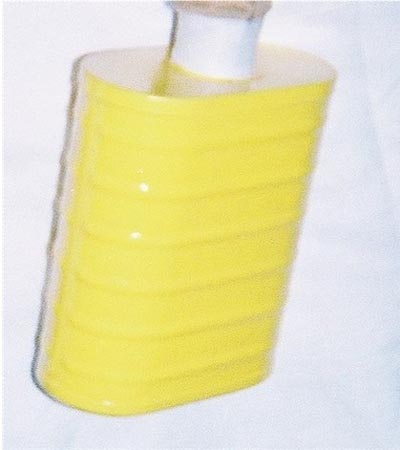
Once the gas mask was apart, I started working on the filter can. Using a flat head screwdriver I popped off the “lid” at the bottom of the can. This piece allowed air to be drawn into the filter can and through the filtering agent before the soldier breathed the air. Removing this piece allowed access to the interior of the can. Once removed I used screwdriver and needle nose pliers to remove all of the filtering material; which included layers of charcoal, cotton and wire mesh screens. Removing these is easy enough, just a little time-consuming. Once the entire filtering agent was removed I sanded down the exterior of the can to remove the old paint and rust. (Figure 2 is a picture of the can emptied of filter agent and prepared for painting, while figure 3 is the newly painted filter can.). Once emptied and cleaned the last step was to paint the filter can. I selected “federal safety yellow” spray paint, which best matched the original yellow color of the filter can, and painted the can.

Figure 2
Figure 3

Once the filter can is completed the next step is the hose. What was needed was a ribbed hose with an opening diameter of about 1 1/8-inch. The replacement hose should match as best as possible the original. Finding a replacement hose may be tricky, but surplus Russian/Soviet, Chinese and East German gas masks are possible inexpensive sources for replacement hoses. Scuba diving shops may also serve as possible sources. For this restoration, I was fortunate to find at a local junk shop, an old trashed 1950’s era US army gas mask with a suitable hose.

Having located a hose it then had to be covered in fabric. I stretched the hose down the length of a dowel rod with a diameter of 1 inch. Once stretched I tacked each end of the hose to keep it stretched at its full length. See figure 4.

Figure 4

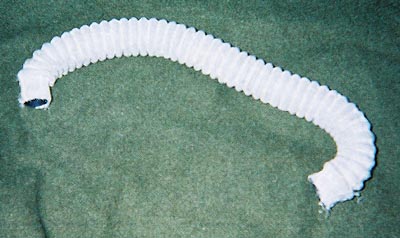
To cover the hose I used cotton muslin from a Red Cross triangle bandage. I cut it so that it would wrap around the hose with the seam running the length of the hose. With the material cut, I applied spray glue to the hose and applied the cloth to the hose and allowed to dry while the hose was still stretched. When the glue dried I removed the hose from the dowel and allowed it to contract to its normal length. When this happens you will find the fabric adheres to the contours of the ribbed hose just fine (see figure 5).

Figure 5

To ensure the match in the color of the replacement hose’s cloth covering with the original I chose to tint the replacement using Partha brand paint color “Asia” mixed with a small amount of water to thin out and then painted onto the cloth. Once dry it was a perfect match for the color of the original hose fabric.

Another option for covering the hose comes from Mr. Mickey Collins, who suggested “medical ‘stockenettes’ as used in Orthopedics is excellent for this as it is a light stretch gauze material. Right color and material weave too! This material comes on long rolls and is cut to length. Generally kept in the clean utility/supply room of a rehab or surgical orthopedic unit in any general hospital.” I am sure this can also be found at most any medical supply or surplus store.

Finally, the mask was left. It was a little stiff and the rubber flaking out of it. I turned the mask inside out and with a small brush I worked out as much of the old rubber as possible. Simply passing the brush over the old rubber probably removed 90% of the crumbling rubber. The fabric of the mask itself still remained strong. I then washed the inside of the mask with a soft damp cloth, including the mouthpiece. To replace the original rubber I painted the interior of the mask with rubber cement and allowed it to dry and cure for two weeks. This solution approximated as best as possible the pliability of a mask with supple and pliable rubber. Another option may prove to be “liquid latex” now available in hardware stores for coating tool handles. After the cement cured the elastic was easily replaced. I have not yet found a suitable replacement for the flutter valve that is usually missing.

When all three components were finished they were assembled into the finished gas mask. The hose was slipped onto the mask and filter cans and new safety wire was used to hold each end of the hose to the mask and can and a white medical tape was placed over the wire.

With the assembly completed I now had a mask very serviceable for WW1 living history and reenacting purposes (the mask, of course, is not intended to actually filter poison gas). Figure 6, is a picture of the completed mask. In the end, the total project cost about $35.00.


Figure 6